How to Read Amigurumi Patterns: Abbreviations, Rounds and Stitch Counts
A round line in a crochet toy pattern has four parts in a fixed order. This guide decodes them, lists the US abbreviations and shows how to check a stitch count.
Tutorial at a glance
Materials
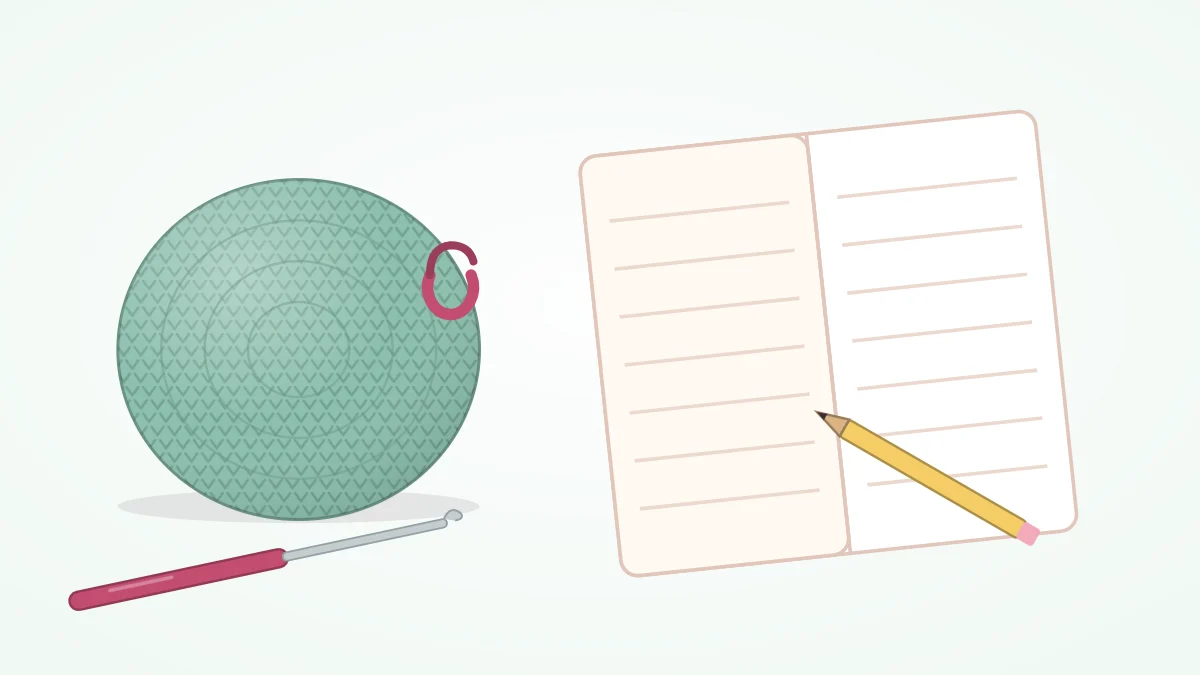
- Worsted weight (#4 medium) yarn in a light color
- 3.5 mm (US E-4) crochet hook
- Locking stitch marker
- Notebook and pencil for tallying rounds
- Blunt yarn (tapestry) needle
Rnd 4: (sc 2, inc) x 6 (24). To someone new to crochet that line looks like algebra, yet it holds only four pieces of information, always in the same order. Learning how to read amigurumi patterns means learning that order and about a dozen abbreviations. This guide uses US crochet terms throughout.
The abbreviations
These are the standard short forms used in every pattern on this site.
| Abbreviation | Stands for | What it means |
|---|---|---|
| MR | magic ring | The adjustable loop most pieces start in |
| ch | chain | A chain stitch; “ch 6” means make six of them |
| st, sts | stitch, stitches | Any stitch of the round below |
| sc | single crochet | The basic amigurumi stitch |
| inc | increase | 2 sc worked into the same stitch |
| dec | invisible decrease | 2 stitches worked together through the front loops |
| sl st | slip stitch | A flat joining stitch with no height |
| hdc | half double crochet | A stitch slightly taller than sc |
| dc | double crochet | A stitch about twice the height of sc |
| FLO | front loop only | Insert the hook under the loop nearest you |
| BLO | back loop only | Insert the hook under the loop farthest from you |
| Rnd | round | One full lap around the piece |
| FO | fasten off | Cut the yarn and pull the tail through the last loop |
Two of these have their own step-by-step guides: the magic ring and the invisible decrease.
The four parts of a round line
Take the opening line apart from left to right:
- Rnd 4 is the round number. It only tells you where you are.
- sc 2, inc is the instruction: one single crochet in each of the next two stitches, then an increase in the stitch after that. A number after “sc” counts stitches to work into. “inc” and “dec” on their own mean one of each.
- ( … ) x 6 is the repeat. Work everything inside the parentheses, then do it again, six times in total. Without parentheses, “inc x 6” simply means six increases in a row.
- (24) is the stitch count: how many stitches the round should hold when it is finished. It is not an instruction.
A line such as Rnds 5-8: sc 24 (24) covers several rounds at once. Work one single crochet in every stitch, for four rounds, with the count staying at 24 each time.
A short example, read line by line
This small piece is a flat circle that turns into a shallow cup. Read each line before looking at the explanation under it.
Practice circle (make 1)
- Rnd 1: 6 sc in MR (6)
- Rnd 2: inc x 6 (12)
- Rnd 3: (sc 1, inc) x 6 (18)
- Rnds 4-5: sc 18 (18)
- FO and weave in the tail.
- Rnd 1: six single crochet worked into the magic ring, which is then pulled closed.
- Rnd 2: an increase in each of the six stitches, doubling them to 12.
- Rnd 3: one plain stitch, one increase, six times. Each repeat uses two stitches and leaves three, so 12 becomes 18.
- Rnds 4-5: two rounds with no increases. The circle stops growing outward and its edge turns upward.
How to check your count
The number in parentheses can be verified with simple arithmetic before you make a single stitch, which is also a quick way to spot a typo in a pattern.
| Instruction | Stitches it uses from the round below | Stitches it leaves in the new round |
|---|---|---|
| sc 1 | 1 | 1 |
| inc | 1 | 2 |
| dec | 2 | 1 |
For (sc 2, inc) x 6, one repeat uses 3 stitches and leaves 4. Six repeats use 18, which must match the previous round, and leave 24, which must match the count at the end of the line. A decrease round works the same way in reverse: (sc 2, dec) x 6 uses 24 and leaves 18.
On the hook, count the V shapes along the top edge of the round, starting at the marked stitch. The loop on the hook itself is not a stitch.
Tip
If a round ends one stitch short or one over, count the repeats instead of the stitches. A missing increase or an extra plain stitch usually shows up as one repeat that looks different from its neighbors.
Rounds, rows and the spiral
A round goes around a tube or circle and ends where it began. A row goes back and forth across a flat piece: at the end you chain one, turn the work and come back the other way. Amigurumi is mostly rounds; rows appear for flat parts such as some ears or wings.
Unless a pattern says “join”, the rounds are worked as a continuous spiral. The last stitch of one round runs straight into the first stitch of the next, with no slip stitch and no chain between them. Because a spiral has no seam, a stitch marker does the job of showing where a round starts. Clip it into the first stitch of the round, and when you come back to it, remove it, make that stitch, and clip it into the new one. Losing the start of the round is high on the list of common amigurumi mistakes, and the marker is the cure.
The US and UK term trap
The two systems use the same words for different stitches, so a pattern followed in the wrong system comes out too tall and too loose.
| US term | UK term for the same stitch |
|---|---|
| single crochet (sc) | double crochet (dc) |
| half double crochet (hdc) | half treble crochet (htr) |
| double crochet (dc) | treble crochet (tr) |
A quick test: if the pattern uses “sc” anywhere, it is written in US terms, because UK terminology has no stitch called single crochet. A toy pattern made almost entirely of “dc” is probably in UK terms and means the US single crochet.
Words that sit outside the round lines
- (make 2) next to a piece name: work the whole piece that many times.
- Stuff placed between two rounds: add fiberfill at that point, before the opening gets too small.
- Leave a long tail: cut the yarn with enough length to sew the piece on.
- In BLO or in FLO at the start of a line: work that whole round into one loop only.
With the notation decoded, the amigurumi ball pattern is a good first full pattern to follow from start to finish.
Frequently asked questions
What does an asterisk mean in a crochet pattern?
Some patterns mark a repeat with asterisks instead of parentheses. Everything between the two asterisks is the repeated section, followed by how many times to work it. It means the same thing as a group in parentheses followed by a multiplier.
What should I do if my stitch count does not match the pattern?
Stop at the end of that round and recount from the marker. If the number is still off, undo the round back to the marker and rework it, counting the repeats as you go. Carrying an error forward shifts every later round, so fixing it straight away is less work.
Does sc 3 mean three stitches in one stitch?
No. In the notation used here, a number after sc means one single crochet in each of that many stitches. When several stitches go into the same place, the pattern says so in words, as in 6 sc in the magic ring, or uses inc for two in one stitch.