Mini Amigurumi Guide: How to Crochet Tiny Toys
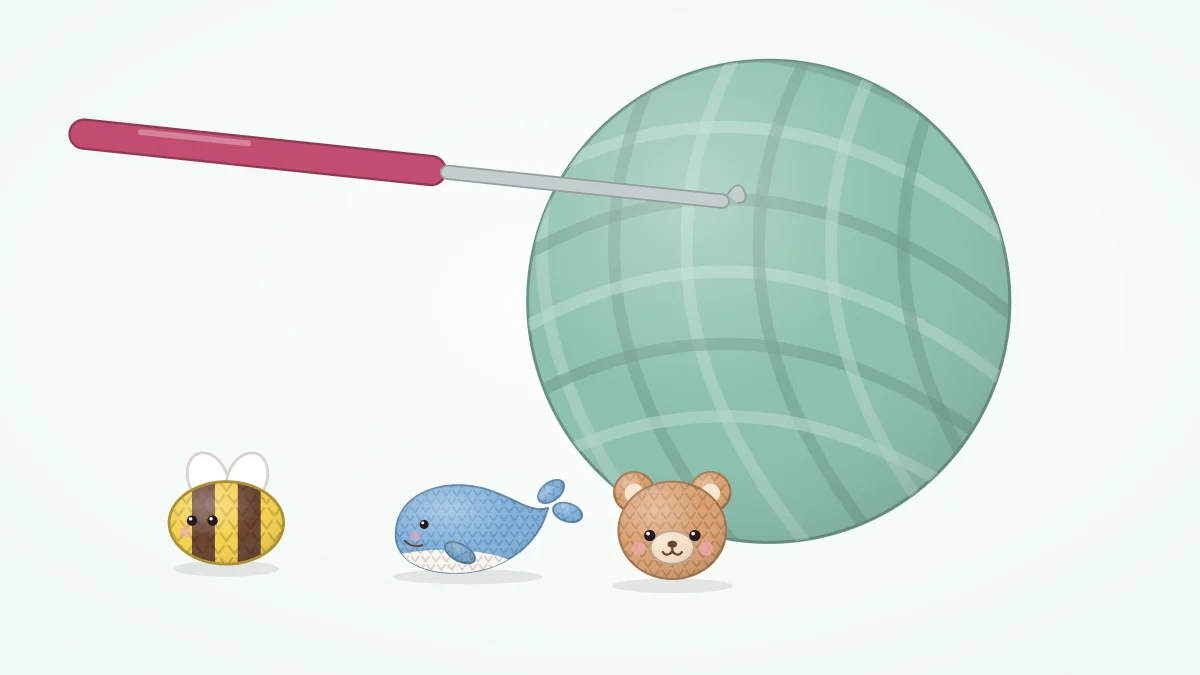
How to make tiny amigurumi: scale any pattern down with finer yarn and a smaller hook, simplify the shapes, handle small stitches, choose tiny eyes and stuff with tweezers.
Tutorial at a glance
Materials
- Fingering or sport weight cotton yarn in a light color
- 2.0-2.5 mm crochet hook
- Scrap of contrasting yarn or a small locking stitch marker
- Polyester fiberfill
- Tweezers and a wooden skewer for stuffing
- Black embroidery thread for French knot eyes
- Fine needle and a blunt yarn needle
- Small sharp scissors
Any pattern becomes smaller the moment it is worked in thinner yarn with a smaller hook. The stitch counts stay the same; only the stitches shrink. That one fact is the basis of mini amigurumi, the pocket-sized toys used as keychains, ornaments and desk companions. The rest is a matter of adapting to small stitches: simpler shapes, different eyes and a new way of getting stuffing inside.
Scale down with yarn and hook
There is no need to rewrite a pattern to make it smaller. Choose a lighter yarn weight, pair it with a hook small enough to keep the fabric dense, and follow the rounds exactly as written.
| Yarn weight | Hook to start with | Result compared with the worsted version |
|---|---|---|
| Worsted (#4 medium) | 3.5 mm (US E-4) | The size the pattern states |
| DK (#3 light) | 3.0 mm | A little smaller |
| Sport (#2 fine) | 2.5 mm | Clearly smaller |
| Fingering (#1 super fine) | 2.0-2.25 mm (up to US B-1) | The smallest of the common yarn weights |
| Crochet thread or embroidery thread | Steel hook around 1.0-1.5 mm | Micro scale; best left until fingering weight feels easy |
Exact sizes depend on the yarn and on tension, so make one piece before committing to a full set. Smooth, tightly twisted cotton is the easiest fiber at this scale because the stitches stay visible; fuzzy yarn hides them. See amigurumi hook sizes for the full hook chart.
Simplify the shapes
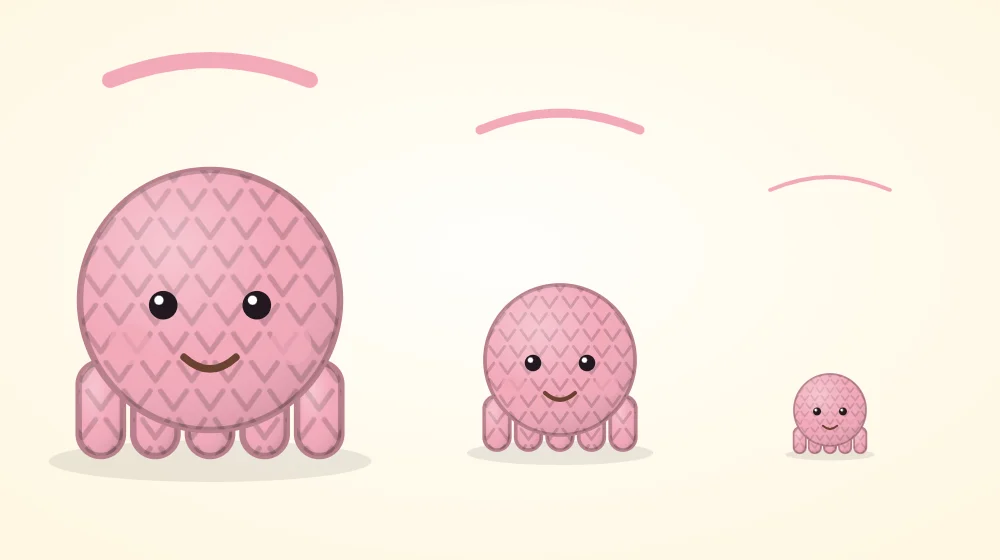
Thinner yarn only goes so far. Below a certain size, a design also needs fewer parts, because details that read clearly on a large toy turn into lumps on a tiny one.
- Fewer rounds. A head that grows to 36 stitches can stop at 18 or 24. Remove the same number of increase rounds and decrease rounds so the piece still closes, and take out some even rounds to keep the proportions.
- Fewer pieces. Work head and body as one shape. A single ball or egg with ears and a face already reads as an animal.
- Flat instead of stuffed. Ears, wings, fins and tails become small flat pieces, or a few stitches worked straight onto the surface.
- Suggest, do not build. Arms can be three embroidered stitches. Legs can be left off a sitting figure altogether.
A mini body to practice on
This small ball is designed as a starting shape for a bee, a chick or a bear head. In fingering weight yarn with a 2.25 mm (US B-1) hook it should come out about 1 in (2.5 cm) across, depending on yarn and tension.
Abbreviations: MR = magic ring, sc = single crochet, inc = increase (2 sc in the same stitch), dec = invisible decrease (sc 2 stitches together through the front loops), Rnd = round, FO = fasten off. Work in a continuous spiral with a stitch marker in the first stitch of each round.
Mini round body (make 1)
- Rnd 1: 6 sc in MR (6)
- Rnd 2: inc x 6 (12)
- Rnd 3: (sc 1, inc) x 6 (18)
- Rnds 4-7: sc 18 (18)
- Add the face now if it will be embroidered from the inside.
- Rnd 8: (sc 1, dec) x 6 (12)
- Stuff firmly, a pinch at a time.
- Rnd 9: dec x 6 (6)
- FO and close the remaining stitches with the yarn tail.
For finished designs at this scale, try the mini amigurumi bee or the mini amigurumi whale.
Handling small stitches
Small stitches are the same stitches, only harder to see and hold. A few habits help:
- Use light-colored yarn for the first attempts. Dark stitches in fine yarn are very hard to count.
- Work under strong, direct light, and add a magnifier if the stitches still blur.
- Mark every round. A short scrap of contrasting yarn laid across the work can stand in for a locking marker that is too heavy for the piece.
- Count as you go. With only 12 or 18 stitches in a round, one missed stitch changes the shape noticeably.
- Relax the grip. Tight hands on a thin hook tire quickly. Short sessions keep tension even.
Tip
The magic ring is the fiddliest moment on a tiny piece. Leave a longer starting tail than usual so there is something to hold, and work the first six stitches loosely; the ring can still be pulled fully closed afterward.
Tiny eyes: beads or French knots
The 6-8 mm safety eyes used on standard toys would cover half a mini face. There are two usual replacements.
Beads
Small round black beads give a glossy eye. Sew each one on with strong thread, passing through the bead several times, and knot the thread inside the piece before closing it.
French knots
Bring a threaded needle out where the eye should be. Wrap the thread around the needle two or three times, hold the wraps snug, and push the needle back in right beside where it came out, not into the same hole. The wraps tighten into a small raised dot. More wraps make a bigger eye. Other stitched features are covered in amigurumi face embroidery.
Watch out
Beads, safety eyes, buttons and pellets are a choking hazard for babies and children under 3, and so is a mini toy itself, because the whole thing is a small part. Embroidered features are the safe choice for faces, and minis belong with older children and adults.
Stuffing with tweezers
Fingers do not fit into an opening of six or twelve small stitches. Pull the fiberfill into wisps no bigger than a fingertip, pick up one at a time with tweezers and place it against the inside wall, working around the piece rather than filling the middle first. The blunt end of the hook or a wooden skewer packs it down.
Mini pieces need firm stuffing to hold their shape, but the fabric stretches quickly at this scale. Stop when the surface feels firm and before white shows between stitches. General principles are in how to stuff amigurumi.
Uses for mini amigurumi
- Keychains and bag charms: sew a loop of yarn to the top, or attach a small jump ring through two stitches and add a keyring. Stuff very firmly, since these get squeezed in pockets.
- Ornaments: a loop of thread through the top of the head turns any mini into a hanging decoration.
- Mobiles and garlands: string several along a length of yarn, hung well out of a baby’s reach.
- Gift toppers: tie one to a parcel with the yarn tail.
Metal rings, clasps and chains are small parts too. Keep anything fitted with hardware away from young children.
Frequently asked questions
Is mini amigurumi harder than regular amigurumi?
The stitches are identical, but they are harder to see and hold, and mistakes show more on a small piece. Most people find it easier after completing a few standard-size projects in worsted weight yarn first.
Can I use embroidery thread instead of yarn for mini amigurumi?
Yes. Embroidery thread and crochet thread work with a small steel hook and give very small results. They are less forgiving than fingering weight yarn because the strands can separate, so it helps to practice with yarn first.
How do I keep a keychain amigurumi from getting dirty and misshapen?
Choose a mid-tone or darker color, crochet tightly and stuff very firmly so the piece resists squeezing. Cotton holds its shape and stitch definition better than fuzzy fibers when it rubs against keys and bags.